
Procurement Stack of 2026
Updated: Mar 17
A Technical Whitepaper for Leaders Building an AI-Native Procurement Control Plane
-Supply Matrix Research Whitepaper | 2026

This whitepaper provides a technical reference model for designing and implementing a modern procurement technology stack in 2026. It is written for CPOs, CIOs/CTOs, Chief Data Officers, Finance leaders, and transformation sponsors who need a stack that is:
composable (not monolithic),
event-driven (not batch-bound),
audit-ready (not “trust us”), and
automation-capable (not “AI wallpaper”).
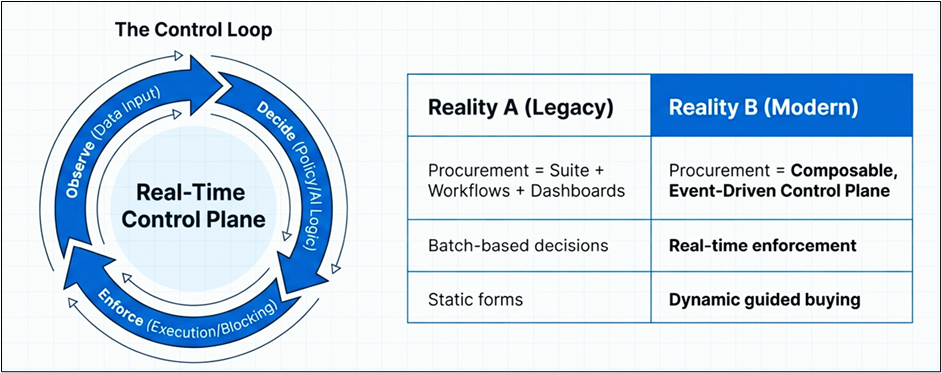
Procurement is evolving from a functional workflow into an enterprise control plane for external spend—a system that continuously observes, decides, and enforces how money is committed and how suppliers are engaged.
In 2026, procurement performance is increasingly determined by the quality of its technology stack across four planes:
Execution Plane – systems that run transactions (requisitions, orders, invoices, payments).
Control Plane – intake, orchestration, policy-as-code, exception handling, channel steering.
Data Plane – canonical procurement objects, semantic layer, event history, feature store.
Trust Plane – identity, access controls, audit trails, observability, model governance.
Most procurement transformations fail for predictable reasons:
AI is applied to broken master data and inconsistent definitions.
Integrations are point-to-point and non-replayable.
Orchestration is embedded inside tools, creating spaghetti automation.
“Savings” becomes a narrative rather than a computable metric.
A successful 2026 procurement stack is designed like a mission-critical distributed system: event-driven, idempotent, observable, secure, and measurable—with AI acting as a bounded execution layer, not a free-form chatbot.
1) Why the Procurement Stack Must Change
1.1 The Hard Truth
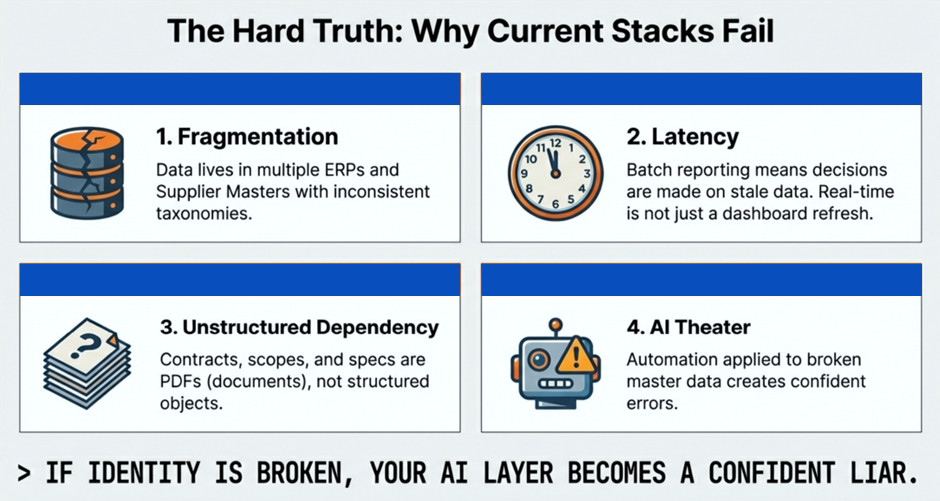
Procurement touches more external entities (suppliers), more unstructured content (contracts/scopes/specs/emails), and more financial controls (commitments and liabilities) than almost any other business function. The traditional suite-centric approach fails under:
Workflow fragmentation (multiple tools and local workarounds)
Data fragmentation (multiple ERPs, multiple supplier masters, inconsistent taxonomies)
Latency (batch reporting; decisions made on yesterday’s truth)
Unstructured dependency (contracts and specs are documents, not structured objects)
Manual exception load (invoice mismatches, noncompliance, supplier onboarding gaps)
Inability to scale (headcount growth required to handle volume and complexity)
1.2 The New Requirement
Procurement must operate as a real-time decision-and-enforcement layer that connects demand to the optimal buying channel and supplier—while enforcing policy, contract, risk, and budget constraints.
2) Design Principles for the 2026 Stack
A leader should insist on these principles as non-negotiables:
Event-driven by default
Every meaningful state change emits an event. Workflows react to events, not scheduled jobs.
Identity is a product, not a table
Supplier, contract, item/service, cost object identifiers must be stable and governed.
Policy-as-code
Procurement rules must be executable and testable, not buried in PDFs and tribal knowledge.
Orchestration separated from execution tools
Workflows span systems; orchestration must live in a dedicated runtime.
Observability and auditability are first-class
You must know what happened, why, who approved, what the system saw, and what it changed.
AI is bounded and measurable
AI components must have clear scopes, thresholds, approvals, and evaluation harnesses.
3) The Reference Model: Four Planes, Seven Layers

3.1 Plane A — Execution (Systems of Record)
Role: transact, post, and preserve the financial/legal truth.
Typical capabilities:
Supplier master records
Purchase requisitions / purchase orders
Goods receipt / service entry
Invoice processing, matching, payment execution
Financial postings and commitments
Key failure mode: execution systems are treated as closed boxes with weak APIs and limited event emission.

3.2 Plane B — Control (Intake + Orchestration + Exceptions)
Role: decide the path and enforce the rules.
Core services:
Intake service: a single front door for all demand (portal/chat/forms/API/email ingestion)
Guided buying: dynamic question flows to capture minimum viable specs and constraints
Channel steering: route demand to catalogue vs contract vs quote vs sourcing vs spot buy
Approval service: configurable approvals with segregation of duties and delegation
Exception/case management: manage deviations as cases with owners, SLAs, and evidence
Key failure mode: organizations implement intake without policy consistency, then adoption collapses.

3.3 Plane C — Data (Procurement Lakehouse + Semantic Layer)
Role: unify truth, enable analytics, and power decision intelligence.
Core components:
Immutable event log (append-only): every procurement state transition
Curated object store: supplier, contract, request, order, invoice, payment, exceptions
Semantic layer: one standard meaning for savings, compliance, cycle time, risk, working capital impact
Feature store (optional but valuable): reusable features for models (e.g., supplier lead time drift, invoice variance patterns)
Key failure mode: Without a semantic layer, Dashboards and AI consume inconsistent definitions; metrics become political. Dashboards become debate clubs where Finance and Procurement argue over metric definitions.

3.4 Plane D — Trust (Security + Audit + Governance)
Role: make the system safe, controllable, and defensible.

Core controls:
Identity & access management (least privilege, role-based access, delegated authority)
Segregation of duties enforced by policy engine
Immutable audit trails of approvals and automated actions
Observability (tracing, logs, metrics) across workflows
Model evaluation, drift monitoring, and change management for AI services
Key failure mode: “automation without audit” leads to incidents, followed by automation bans.
4) Target Architecture Blueprint (Production-Grade)
4.1 Logical architecture (service-level)
Channel layer
Portal / mobile / chat
Email ingestion (structured extraction + classification)
API integration (for upstream apps like engineering requests)
Core control plane services
Intake & request normalization
Policy engine (policy-as-code)
Routing & channel steering
Orchestration runtime (workflow engine)
Exception/case service
Supplier onboarding workflow service
Contract compliance service
Integration fabric
API gateway + service mesh (optional)
Event backbone (publish/subscribe)
Connector services to execution systems and supplier networks
Document ingestion pipeline (contracts/specs/invoices/emails)
Data plane
Event store
Curated object store
Semantic layer
Analytics serving layer
Model feature store
AI/decision services
Retrieval layer over governed knowledge (contracts, policy, supplier records)
Extraction/classification services (spend, invoices, scope attributes)
Anomaly detection (leakage, duplicates, suspicious variance)
Optimization engines (where math dominates; e.g., award scenarios)
Agent runtime (bounded, approval-driven execution)
Trust plane
Audit log store (tamper-evident)
Observability stack (tracing, metrics, alerting)
Model registry + evaluation harness
Security controls (secrets management, token rotation, access reviews)
5) The Procurement Object Model (Canonical Data Contract)
If you want a real stack, require a canonical schema that every system aligns to.

5.1 Core objects
Supplier: identity, hierarchy, capabilities, risk signals, onboarding status
Contract: versioned document + extracted obligations, pricing terms, renewal rules
Category taxonomy: versioned mapping, governance process, confidence scores
Request: demand intent, constraints, spec attributes, budget/chargeback fields
Order: commitments, line items, delivery/service milestones
Invoice: claim, matching status, exceptions, evidence
Payment: cash event, remittance references
Case/Exception: type, root cause, owner, SLA, resolution evidence
Policy rule: machine-executable logic with tests and change history
Risk signal: source, timestamp, severity, impact mapping
5.2 Data quality gates
Uniqueness: no duplicate supplier identities across systems
Referential integrity: invoices always link to orders/contracts where applicable
Completeness: required attributes for automation readiness exist
Timeliness: events arrive within defined latency envelopes
Lineage: every metric traceable to underlying events/objects
6) Integration Strategy: How Procurement Connects to Reality
6.1 Three integration modes (must coexist)
API-based
For modern suppliers and internal systems. Supports real-time interactions, status updates, and orchestration call backs.
Document-based ingestion
For contracts, statements of work, specifications, invoice PDFs, emails. Requires extraction pipelines + confidence scoring + human verification loops.
Structured B2B exchange
For high-volume order/invoice flows where structured formats dominate. Requires mapping, validation, acknowledgements, and reconciliation.

6.2 Event-driven mechanics (what “real-time” actually means)
Real-time procurement is not a dashboard refresh rate. It’s the ability for the control plane to react to events:
Request approved → route to best channel; create workflow instance
Supplier onboarding completed → unlock ordering routes
Contract renewal window opens → trigger renewal playbook workflow
Invoice variance detected → create exception case; pause payment path; request evidence
6.3 Reliability patterns (non-negotiable engineering)
Idempotency keys for every create/submit action
Retry with backoff and dead-letter queues for connector failures
Compensation workflows for partial failures (rollback patterns)
Replayability: ability to reprocess events to rebuild state and debug defects
Schema versioning for events and objects to avoid breaking downstream consumers
7) AI and Decision Intelligence: Technical Implementation Without “AI Theater”

7.1 AI is a set of bounded services
A production-grade procurement AI layer is composed of:
Retrieval + grounded reasoning service
Answers questions using governed procurement knowledge (policies, contracts, suppliers). Must enforce permission filters and cite internal evidence (within the system).
Extraction services
Turn documents into structured attributes: clause types, obligations, pricing terms, scope attributes, invoice line item normalization.
Classification services
Category classification, spend mapping, risk categorization, request routing classification.
Anomaly detection services
Detect leakage, duplicates, unusual price variance, split orders, suspicious supplier patterns.
Optimization engines
Used where combinatorics and constraints dominate (award allocation, scenario comparisons).
7.2 Agent runtime: “bounded autonomy” architecture
Procurement agents become valuable only when:
scoped to defined tasks,
constrained by policy,
gated by approval thresholds,
logged comprehensively.
Agent workflow pattern
Receive a structured task (e.g., “prepare sourcing package”)
Pull required evidence via retrieval layer (contracts, policies, historical pricing)
Generate artifacts (bid sheet, supplier shortlist, negotiation pack)
Validate against policy (budget, preferred suppliers, risk thresholds)
Submit for approval if above threshold
Execute actions via connectors (create event, notify suppliers, draft orders)
Log everything (inputs, outputs, confidence, approvals, actions)
7.3 Model governance (how leaders prevent automation disasters)
Evaluation harness per task type (accuracy, false positives/negatives, drift)
Confidence thresholds with escalation paths
Human verification loops for low-confidence extraction
Canary releases for model updates
Incident playbooks for model regressions (rollback plans)
8) Business Impact Mapping: How the Stack Drives Enterprise KPIs
A leader-grade procurement stack must explicitly map technical outputs to business outcomes:
Margin / cost
Contract price enforcement → leakage reduction
Spec standardization → cost avoidance
Guided buying → preferred supplier compliance
Cash / working capital
Invoice accuracy and dispute reduction → faster close, better cash predictability
Payment term governance → improved cash conversion
Exception SLAs → reduced stuck liabilities
Resilience / continuity
Supplier risk signal ingestion + routing blocks → fewer disruptions
Faster onboarding + alternative sourcing workflows → reduced recovery time
Speed to execute
Intake + orchestration → cycle time reduction
Agent-assisted packaging and approvals → throughput scaling without headcount
Management truth
Semantic layer → “one metric, one meaning” across procurement/finance/operations
If this mapping is absent, the program becomes tool-led, not outcome-led.

9) Implementation Roadmap (Leader-Ready, Engineering-Realistic)
Phase 1 — Build the spine (0–10 weeks)
Deliverables:
Canonical supplier + contract identity strategy
Event capture from core systems (request/order/invoice/payment)
Intake front door (even if routing is basic)
Audit logging + role model baseline
Success criteria:
You can trace a transaction end-to-end with identifiers and events
You can compute baseline cycle time, compliance, and exception rate reliably
Phase 2 — Orchestrate one end-to-end workflow (10–20 weeks)
Deliverables:
Workflow runtime + case management
Policy-as-code for approvals and routing
One standardized path (e.g., contract-first buying or invoice exception handling)
Success criteria:
Reduced exception resolution time
Reduced manual touchpoints per transaction
Clear audit trail for approvals and exceptions
Phase 3 — Deploy one bounded agentic workflow (20–36 weeks)
Pick one:
Invoice-to-contract compliance + leakage detection
Tail spend triage + guided buying
Contract renewal detection + obligation tracking
Success criteria:
Measurable throughput increase
Strict control adherence (zero high-risk auto-executions)
Model evaluation metrics stable and monitored
Phase 4 — Scale decision services (6–12 months)
Deliverables:
Category control tower (signal-driven, not static reporting)
Advanced anomaly detection and scenario simulation
Multi-workflow orchestration across business units
Mature semantic layer governance
Success criteria:
Procurement becomes predictive and preventive, not reactive
Management trust in metrics increases (fewer metric debates)
10) Key Risks and Failure Modes
Master data denial
If supplier and contract identities are not fixed, nothing else scales—especially AI.
Batch-only telemetry
If events don’t flow in near real time, orchestration becomes delayed bureaucracy.
Workflow sprawl
Embedding workflows inside each tool creates unchangeable spaghetti.
No semantic layer
If definitions vary, KPIs cannot be trusted and automation cannot be validated.
Agent overreach
Unbounded agents create high-severity incidents and cause leadership to shut down automation.
No engineering ownership
If procurement expects IT to “install a stack” without a product-engineering model, you plateau at pilots.
11) What Leaders Must Decide Up Front
Control plane ownership: who owns policy-as-code and routing logic?
Identity governance: who owns supplier and contract identity across systems?
Event backbone commitment: are we event-driven, or pretending?
Semantic layer authority: who defines savings, compliance, and risk—and how is it enforced?
Automation risk appetite: what can auto-execute, what requires approval, what is prohibited?
Operating model: do we build procurement product teams or run perpetual projects?
These decisions determine whether the stack becomes an enterprise capability or a tool graveyard.
Conclusion
The procurement stack of 2026 is not a shopping exercise. It is an engineering and operating model transformation. The winning architecture is:
event-driven (so decisions are timely),
policy-controlled (so behaviour is enforceable),
data-governed (so truth is consistent),
audit-ready (so automation is safe), and
AI-enabled (so execution scales without headcount).
Build it as a control plane, and procurement becomes a measurable driver of margin, cash, and resilience. Build it as a suite rollout with AI bolted on, and you will automate complexity instead of eliminating it


Comments