
The Procurement AI Readiness & Transformation Playbook (2026)

Updated: Apr 1
Supply Matrix Research Whitepaper | 2026

A lot of procurement teams are living the same movie right now
You run a GenAI pilot. The demo looks great. Everyone nods. Then the CFO asks one question that kills the room:
“Nice. Where does it show up in the P&L, and how do we control the risk?”
That’s the 2026 reality. AI is no longer a “cool initiative.” It’s becoming a capability test: can procurement deliver faster decisions, stronger compliance, less leakage, and better resilience—without breaking governance?
And here’s the kicker: many organizations will fail not because the AI is weak, but because their procurement operating model is not built to scale AI safely. Gartner predicts more than 40% of agentic AI projects will be cancelled by end-2027, citing cost, unclear value, and inadequate risk controls.
So this guide is designed to do one thing: help procurement organizations build AI readiness that survives contact with Finance, Audit, Legal, IT, and reality.
Why 2026 is different: agentic AI changes the job, not just the tools
GenAI was phase one: drafting, summarizing, answering. Useful—mostly assistive.
Agentic AI is phase two: systems that can plan, decide, and execute tasks under guardrails. McKinsey frames this shift as changing what procurement can achieve—moving procurement away from transaction work and toward growth, sustainability, and resilience impact.
This is also why the failure risk spikes. When systems can act, you need controls that look more like finance systems than “innovation labs.”

The 30 capability elements of modern procurement: what the AI-ready function actually needs.
The Model: AI readiness is a layered system (not a checklist)
Most procurement AI programs stall because they start at the top: use cases and tools.
But AI readiness is built bottom-up:
Bedrock: data + process discipline (otherwise automation becomes chaos at machine speed)
Engine: tooling + integration + safe execution patterns
Radar: intelligence that turns signals into actions (not just dashboards)
Ecosystem: supplier risk + relationship health (continuous, not quarterly)
Control tower: validation + governance + CFO-grade value tracking

The hierarchy of capability: Bedrock → Engine → Applications → Control Tower
The 5 Pillars of Procurement AI Readiness (2026)
Pillar 1 : The Bedrock
a) Data hygiene (clean inputs or clean disasters)
AI is a multiplier. With good data, it’s leverage. With bad data, it’s confident nonsense at scale.
The bedrock question is simple: Can your procurement data support automated decisions?
What “good” looks like :
One supplier master truth (deduplicated, parent-child hierarchies, ownership defined)
Stable category taxonomy (governed, measurable classification accuracy)
Contract metadata that can be queried (expiry, obligations, pricing logic, clauses)
Traceability: Spend → Supplier → Contract → PO → Invoice for top categories
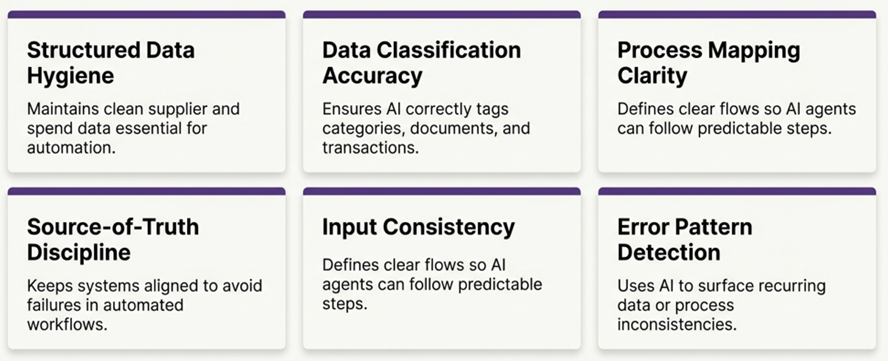
The ruthless warning : If your team can’t agree on “what is the truth” for suppliers, contracts, and spend, then AI will not create clarity—it will amplify disagreement.
b) Process discipline: workflows machines can understand
AI doesn’t “fix” broken processes. It automates them.
If your intake is chaotic and approvals are inconsistent, agents will either:
cause risk (wrong buying), or
get neutered (everything escalates, nothing scales)
What “good” looks like
Clear process maps (what happens, when, and who owns exceptions)
A single “front door” for requests (intake discipline)
Source-of-truth discipline (no shadow trackers governing reality)
Error-pattern detection: you treat process failures as system defects, not individual mistakes
Pillar 2 : The Engine
a) Tooling, engineering, and integration mindset
Most procurement teams buy tools like they buy gym memberships: optimistic, under-used, and then blamed for not working.
AI readiness means procurement can answer: Where will AI run, what will it touch, and how will it integrate with systems of record?
What “good” looks like
A defined tool stack (ERP + Source-to-Pay + Contract Lifecycle + analytics layer)
Integration patterns (application programming interface connectivity, event triggers, permissions)
Prompt + workflow assets reusable across categories (templates, playbooks, clause libraries)
A “production mindset”: monitoring, logging, failure handling—not demo videos

Pillar 2: Tooling & engineering—model selection, prompt mastery, integration mindset.
The hard trade-off
You can move fast with standalone co-pilots. But you only scale value when AI is embedded where work happens (intake, RFx, contracting, invoice validation).
Accenture’s platform strategy research argues leaders treat platforms as living systems of intelligence and outperform peers materially when AI, platform, and business strategy align.
b) Agents & autonomy: speed with seatbelts
Agentic AI is powerful, but procurement is not a sandbox. It’s a control environment.
Gartner’s warning about agentic AI cancellations is basically a memo from the future:
lack of controls kills adoption.
What “good” looks like
Clear autonomy boundaries (what the agent can do alone vs what needs approval)
Controlled workflows (approval gates, escalation paths, kill switch)
Monitoring and logging discipline (traceability: who/what/why)
Segregation of duties preserved (automation doesn’t become a policy bypass)

Pillar 2: Agents & autonomy—workflow design, boundaries, monitoring & logging.
Pillar 3 : The Radar
a) Market intelligence that drives decisions
Most procurement “intelligence” is descriptive: dashboards of what already happened.
AI-ready procurement builds a radar that answers: What is changing, why does it matter, and what do we do next?
What “good” looks like
Market signal interpretation (prices, supply constraints, geopolitical effects, capacity shifts)
Demand pattern recognition (what changed internally, what changed externally)
Benchmark extraction (competitive/industry pricing signals, performance norms)
Playbook linkage: every signal triggers an action pathway (not a PDF report)
b) Sourcing strategy: faster cycles, better outcomes
AI should not just help you draft RFQs. It should help you run smarter sourcing:
Better supplier shortlists
Better award scenarios
Better negotiation prep
Better category strategy structure
Reality check
If your sourcing strategy lives inside a few senior people’s heads, AI won’t fix the fragility. But AI can help you codify strategies into reusable playbooks—if you build the operating model around it.
Pillar 4 : The Ecosystem
a) Risk & signals (continuous, not quarterly)
Supplier risk management is often periodic. AI-ready procurement makes it continuous.
Kearney’s global AI assessment report highlights the maturity gap: many expect growth impact from GenAI, but only a small fraction qualify as “leaders” on maturity and scaling discipline.
What “good” looks like
Performance signal monitoring (delivery, quality, responsiveness, claims)
Risk pattern detection (financial stress, geo exposure, cyber, compliance flags)
ESG insight integration (not as a slide, as a decision input)
Clear playbooks: what to do when alerts fire

The Risk Radar
b) Relationship health: trust, fairness, and bias controls
AI can improve relationships—or quietly poison them—depending on transparency and bias control.
What “good” looks like
Communication summarization that is accurate and shareable
Relationship health assessment (sentiment + recurring themes + issue trends)
Bias-safe scoring (auditable criteria, not “vibes in a model”)
Pillar 5 : The Control Tower
a) Validation (trust, but verify)
This is where most AI procurement programs either graduate… or die.
Because procurement is not judged by “AI usage.” It’s judged by:
whether the outcome is correct
whether it is compliant
whether it is auditable
whether it created validated value
Deloitte’s 2025 Global CPO Survey analysis emphasizes that strong performance correlates with combining technology capability and talent—humans staying in the loop to maximize outcomes.
b) Strategy & Value: CFO-grade measurement or it doesn’t count
This is where procurement earns credibility.
What “good” looks like
ROI framing that Finance agrees with (baseline logic, leakage definition, benefit timing)
Strategic alignment (AI use cases tied to business KPIs, not procurement vanity metrics)
Negotiation scenario testing (award options quantified under constraints and risks)
BCG’s “first 100 days” procurement guidance is blunt: leaders must show tangible wins—real savings, smoother processes, reduced risk, and early evidence of AI improving performance.
The transformation roadmap: how to move from pilots to scale (without crashing)
Here’s a pragmatic sequencing that works in real organizations:
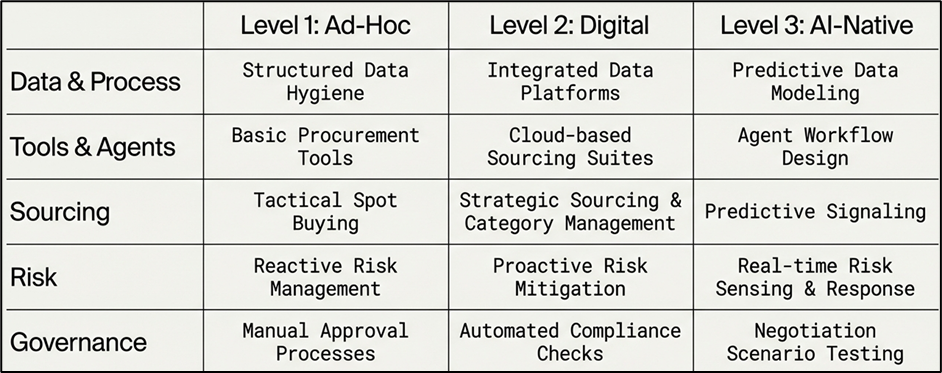
Phase 0 : Readiness diagnosis
Map your top 10 value pools (leakage, compliance, cycle time, category savings, risk)
Assess pillars 1–5 honestly
Select 2–3 “safe ROI” use cases for a controlled pilot
Define control design: approvals, logs, escalation, ownership, Finance validation
Phase 1 : Build the bedrock + ship one production workflow
Goal: prove value with something real (connected to core systems), not a standalone demo.
Stabilize minimum foundations: supplier master, taxonomy basics, contract repository structure, intake/approval rules
Pick one workflow that touches ERP/Source-to-Pay/Contract system and can show CFO-grade value, e.g.
a) Contract intelligence + renewal tracking
b) Tail spend triage + guided buying
c) Invoice-to-contract compliance + leakage detection
d) Define baseline + measurement upfront (what “success” means in numbers)
Exit criteria: one workflow live, adopted, measurable (cycle time / compliance / leakage / verified savings).
Phase 2 : Add agentic execution with guardrails
Goal: Move from “AI assists” to “AI executes—under approval”.
Add bounded autonomy: agent prepares, recommends, drafts, routes; human approves before execution
Expand to a second workflow in a high-volume category/process
Strengthen the control tower metrics: verified savings, cycle time reduction, compliance uplift, exception rate
Exit criteria: 2 workflows live, approval-gated execution working, controls + measurement trusted.
Phase 3 : Scale with a repeatable rollout engine
Goal: Stop doing “projects”; start doing repeatable deployments.
Standardize one deployment playbook: intake → design → build → test → deploy → monitor
Reuse the same control package everywhere: audit trail, approvals, escalation, access control, kill switch
Scale to 5–8 workflows across intake, sourcing, contracts, buying, supplier management
Enforce data governance so quality doesn’t drift (taxonomy + supplier master + contract metadata)
Exit criteria: faster rollout per workflow, stable compliance, Finance accepts value numbers as “real”.
Phase 4 : Controlled autonomy (exception-based management)
Goal: AI executes low-risk work automatically; humans manage exceptions + strategy.
Allow autonomy only in narrow, low-risk domains (catalog/contract-priced buys, thresholds, approved suppliers)
Shift from “approve everything” to “review exceptions”: AI runs, humans intervene only on anomalies
Run a monthly control tower cadence: exceptions, control breaches, audit samples, realized vs forecast value
Exit criteria : 30–60% touchless execution in low-risk scope, with stable controls and consistent verified value.
This report synthesizes publicly available research, market outlooks, and industry analysis published between late 2024 and early 2026. Insights have been interpreted and contextualized through the lens of Procurement and Supply Chain strategy by Supply Matrix Research.
Gartner — Press Release / Website report (2025).
McKinsey — Redefining procurement performance in the era of agentic AI (2026).
Accenture — The new rules of platform strategy in the age of agentic AI (2025).
Kearney — Global AI Assessment (AIA) 2024: the drive for greater maturity, scale, and impact(2024).
Deloitte — 2025 Global Chief Procurement Officer Survey (2025).
BCG — The Procurement Leader’s First 100 Days: Building Momentum That Lasts (2026).


Comments